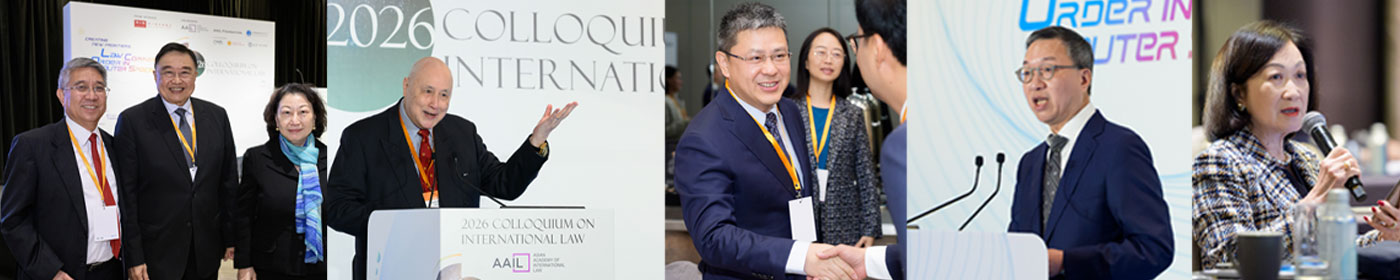
This annual flagship event of AAIL has brought together over 190 legal experts, industry leaders, government officials, and institutional leaders representing 43 jurisdictions to reflect on the growing global interest in the legal, commercial, and governance challenges arising from the rapidly evolving space economy.
The Colloquium kicked off with welcoming remarks by Dr Anthony Neoh SC JP, Chairman of AAIL, who reaffirmed AAIL’s commitment to advancing international legal scholarship across Asia and welcomed delegates to this timely discussion on the legal frontiers of outer space. The Honourable Mr Paul Lam, Secretary for Justice of the Hong Kong SAR, highlighted Hong Kong’s ambition to strengthen its position as a leading international legal and dispute resolution hub for emerging industries, including the space economy. Mr Zhang Changwei, Deputy Commissioner of the Office of the Commissioner of the Ministry of Foreign Affairs of the People’s Republic of China in the Hong Kong SAR, underscored China’s commitment to multilateral cooperation in the governance of outer space. Ms Kamalinne Pinitpuvadol, Secretary-General of AALCO, reflected on the organisation’s role in fostering dialogue among Asian and African States regarding the legal implications of the commercialisation of outer space.
The opening session was followed by keynote addresses by the Honourable Professor Teresa Cheng, Secretary-General of the International Organization for Mediation (IoMed), who explored the growing role of mediation as a complementary mechanism for resolving cross-border commercial and space-related disputes, and Ms Aarti Holla-Maini, Director of the United Nations Office for Outer Space Affairs (UNOOSA), who joined via video to examine the evolving international regulatory framework governing outer space activities and UNOOSA’s efforts to promote international cooperation amid accelerating commercialisation. Before the commencement of the first panel discussion, the Honourable Regina Ip Lau Suk-yee, Convenor of the Non-Official Members of the Executive Council of the Hong Kong SAR Government, highlighted Hong Kong’s strategic role in supporting the development of the space economy through its well established legal and dispute resolution infrastructure.
Moderated by Mr Justin D’Agostino MH, Global CEO of Herbert Smith Freehills Kramer, the first panel examined the commercial dimensions of the New Space Economy. Professor David Peng explored the emergence of the ‘astropreneur’ and the growing investment landscape for space ventures. Ms Kathrine Ke discussed the financing and insurance considerations underpinning commercial space projects, while Dr Sorajak Kasemsuvan placed these developments within the broader context of maritime and aerospace law. Mr Fred Ho concluded the session by offering an industry perspective on the increasing importance of space traffic management.
The second panel, chaired by Dr Anthony Neoh SC JP, turned to the governance of outer space. Ms Rosanna Deim-Hoffman of UNOOSA examined international approaches to space traffic coordination, Dr Jae Woon Lee considered the evolving relationship between airspace and outer space governance, and Professor Su Jinyuan discussed liability regimes and dispute resolution mechanisms relating to space debris.
The third panel, moderated by Mr Paul Starr, Partner of King & Wood, focused on dispute resolution in the commercial space sector. Dr Suwijak Chandaphan outlined the fragmented legal framework governing commercial space disputes, while Professor Lalin Kovudhikulrungsri drew on the Devas v Antrix and Hopewell v Thailand cases to illustrate the challenges faced by developing States. Mr Simon Chapman KC argued that arbitration offers a particularly flexible and effective mechanism for resolving commercial space disputes, highlighting Hong Kong’s unique position as China’s only common law jurisdiction. Professor Zhao Yun JP concluded the discussion by emphasising Hong Kong’s readiness to serve as an international dispute resolution hub for the space economy.
In his closing remarks, Dr Stephen Wong, Head of Chief Executive’s Policy Unit, The Government of the Hong Kong SAR, reflected on the common governance challenges presented by emerging technologies and highlighted Hong Kong’s strategic roles under the National 15th Five-Year Plan, such as an international legal and dispute resolution hub for the Asia-Pacific region, a global supply chain centre, and a regional risk management centre.
The Colloquium reaffirmed the Hong Kong SAR’s growing role at the intersection of international law, innovation, and the New Space Economy. It also underscored AAIL’s continued commitment to fostering cross-jurisdictional dialogue and developing legal frameworks capable of supporting the next frontier of commercial and technological advancement.